

How to Sleep Comfortably During Pregnancy: Tips That Actually Work
Somewhere around the second trimester, sleep stops being something that just happens — and starts being something you have to work for.
Nobody tells you that the exhaustion of pregnancy and the inability to actually sleep well can exist at the same time. You’re tired beyond words, you finally lie down — and then you’re too uncomfortable, too hot, too achy, or too aware of needing the bathroom to drift off properly.
It’s one of the more frustrating parts of being pregnant. And it gets harder as the months go on.
The good news is that sleeping comfortably during pregnancy is genuinely possible with the right setup. Not perfect sleep — that might be off the table for a while — but real, restorative rest that leaves you feeling like a functioning human. These are the tips that actually make a difference.

The right environment does half the work before you even close your eyes.
Why Sleep Gets So Hard During Pregnancy
Before getting into the fixes, it helps to understand what’s actually happening. Sleep problems during pregnancy aren’t random — they come from a handful of very specific causes, and most of them are fixable once you know what you’re dealing with.
Back pain, hip pressure, rib aches, round ligament twinges — your body is changing fast and sleep positions that used to work don’t anymore.
Your kidneys are working harder and the baby is putting pressure on your bladder. Waking two or three times a night is completely normal.
Especially common in the third trimester. Lying flat makes it worse — which is why position and elevation matter so much.
Pregnancy raises your core temperature, which makes night sweats and overheating surprisingly common — even in cool weather.
That crawling, uncomfortable sensation in your legs at night affects a significant number of pregnant women — and tends to get worse in the third trimester.
Anxious thoughts, baby planning, worrying about sleep itself — the mental load of pregnancy can keep you wired long after your body is ready to rest.
Most people experience a mix of these, not just one. So the approach that works best is usually tackling a few things at once — your position, your environment, and your wind-down routine — rather than looking for a single fix.
Start With Your Pillow Setup
This is where most of the discomfort actually comes from, and it’s also where the easiest wins are. The right pillow arrangement takes pressure off your hips, stops you rolling onto your back, and supports your bump — which makes a noticeable difference to how rested you feel in the morning.
The classic setup that works
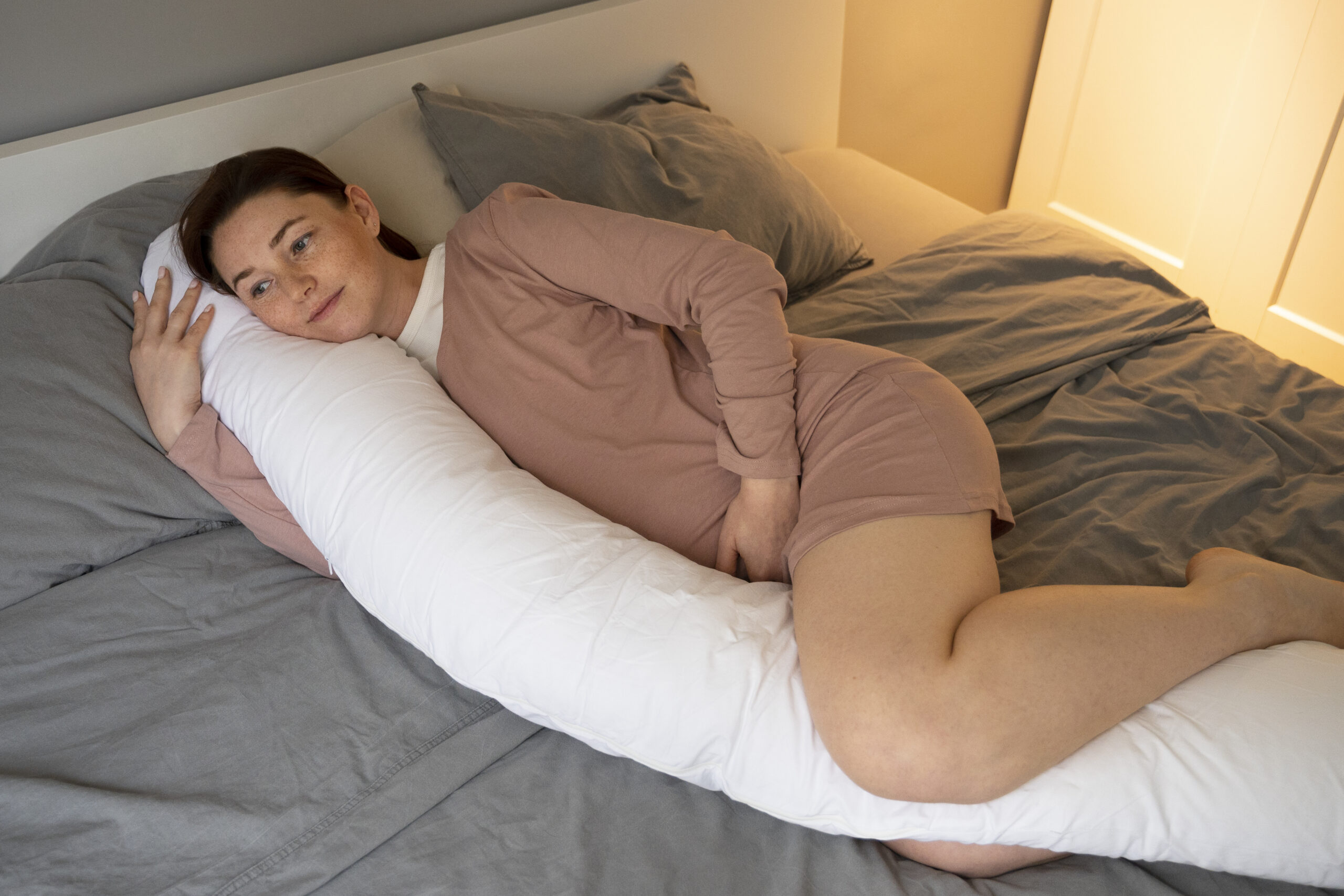
Sleep on your side — left side is slightly preferred for circulation, but right side is fine too — with one pillow between your knees and one supporting your bump from underneath. That’s it. It keeps your hips level, reduces lower back strain, and takes the gravitational pull off your belly.
If you keep rolling onto your back at night, tuck a pillow behind you. It acts as a gentle barrier and works better than you’d expect.
A pillow between your knees doesn’t need to be thick — a standard bed pillow folded once is usually the right height. Too thick and it tips your hips out of alignment. Too thin and it does nothing. Trial and error, but it doesn’t take long to find what feels right.
When to consider a pregnancy pillow
If you’re spending more than a few minutes rearranging pillows every time you roll over, a dedicated pregnancy pillow is worth considering. A full-length pregnancy body pillow wraps around you and handles the knee, bump, and back support in one piece — so when you shift position, the support moves with you.
They’re bulky, and your partner might have opinions about the new addition to the bed. But most women who use one say it’s one of the better decisions they made during pregnancy.
If you want something smaller and less intrusive, a pregnancy wedge pillow tucks neatly under your bump or behind your back. Much less bed real estate, and it travels well too.

A good pillow setup takes minutes to arrange and makes hours of difference.
The Most Common Pregnancy Sleep Problems — and What Actually Helps
Rather than a generic list of tips, here’s what actually works for the specific things that tend to interrupt sleep during pregnancy.
When every position feels wrong
Hip pain from side sleeping is one of the most common complaints, especially in the second and third trimesters. The fix is almost always about alignment — your hips need to stay stacked, not twisted. A pillow between your knees is usually the first thing to try. If your mattress is on the firmer side, a soft mattress topper can take the edge off pressure points significantly.
Alternating which side you sleep on throughout the night also helps — staying on one side for hours puts a lot of sustained pressure on the same hip. Roll over when you naturally wake up and give the other side a turn.
When lying down makes it worse
Nighttime heartburn during pregnancy is almost always positional. Lying flat allows stomach acid to travel upward more easily — so even a slight elevation of your upper body makes a real difference. You can prop up the head of your mattress with a wedge, use an extra pillow under your shoulders (not just your head), or try a bed wedge pillow designed for this purpose.
On the dietary side, keeping dinner light and finishing eating at least two hours before bed helps reduce how much your body has to process while you’re lying down.
When you’re too warm to sleep
Pregnancy raises your resting body temperature, which means the bedding that was fine before might feel stifling now. The most effective change is switching to breathable, moisture-wicking sheets. Bamboo bed sheets are particularly good for this — they regulate temperature naturally and feel noticeably cooler than standard cotton or synthetic blends.
Keeping the bedroom cool (around 18–20°C / 65–68°F) and using a lighter duvet or blanket on your side of the bed are simple changes that make a big difference.
When you can’t stay asleep
Bathroom trips are hard to avoid entirely — your body needs what it needs. But you can reduce how disruptive they are. Keep the path to the bathroom as dark as possible (a dim nightlight is better than turning on the main light), avoid picking up your phone when you wake, and try not to fully “wake up” your brain. The goal is to stay in a half-awake state so falling back asleep is easier.
Tapering fluids in the hour or two before bed — while staying well-hydrated earlier in the day — also helps reduce the frequency without compromising your intake.
When your legs won’t settle
Restless leg syndrome is more common during pregnancy than most people realise, often linked to low iron or folate levels. If it’s a persistent issue, it’s worth mentioning to your midwife or doctor. In the meantime, gentle leg stretches before bed, a warm bath or shower in the evening, and avoiding sitting still for long periods during the day can all reduce the intensity.
Solving the specific thing that’s keeping you awake matters more than any general advice.
Make Your Bedroom Actually Work for You
Your sleep environment matters at any stage of life — but during pregnancy, when your body is already fighting against you, a bedroom that isn’t set up well makes everything harder.
Temperature is everything
A cool, dark room is the single most effective environmental change most people can make. Your core temperature drops naturally as you fall asleep — a warm room fights that process. Aim for somewhere between 18 and 20°C (around 65–68°F). If you and your partner have different temperature preferences, a lighter blanket on your side of the bed is an easy compromise.
Darkness and light
Light — even small amounts — suppresses melatonin, the hormone that signals your body to sleep. Blackout curtains or a good sleep mask are worth it if streetlights or early morning sun are coming through. It’s a small change that has an outsized effect on sleep quality.
Noise
If noise is a problem — a snoring partner, street sounds, a restless mind that amplifies every little thing — a white noise machine or a simple fan can help. The consistent background sound masks disruptive noises and gives your brain something steady to tune out against.
You don’t need to overhaul your bedroom entirely. Pick the one thing that’s most obviously wrong — the room is too warm, there’s too much light coming in, you keep waking from noise — and fix that first. One targeted change often makes more difference than several vague improvements at once.
A Wind-Down Routine That Actually Helps
Pregnancy has a way of filling your head with things to think about — appointments, preparations, worries, plans. Lying down in a quiet room often makes all of that louder, not quieter. A simple pre-bed routine gives your nervous system a clear signal that it’s time to let go of the day.
It doesn’t need to be elaborate. Even 20–30 minutes of deliberate wind-down makes a real difference.
- A warm shower or bath — the drop in body temperature afterward naturally promotes sleepiness. Keep it warm rather than hot, and aim for about an hour before bed
- Gentle stretching — even five minutes of light movement can release the physical tension that builds up during the day, especially in your hips and lower back
- Put the phone down — screens keep your brain alert and the content is often stimulating (even when it feels like mindless scrolling). Try to finish screen time at least 30 minutes before you want to sleep
- A warm, non-caffeinated drink — herbal teas like chamomile or ginger are popular choices. Check with your midwife if you’re unsure about specific herbs during pregnancy
- Something that quiets your mind — a few pages of a book, some gentle breathing, light journaling, or just lying still with your eyes closed without expecting to sleep immediately
The point isn’t to follow a rigid ritual — it’s to create a predictable transition between being awake and being asleep. Your brain learns the pattern surprisingly quickly.

A calm wind-down routine signals your body that sleep is coming — and it actually listens.
What You Do During the Day Matters Too
Sleep quality at night is often decided by what happens during the hours before it. A few small daytime habits make bedtime noticeably easier.
Move your body
Gentle movement during the day — walking, prenatal yoga, light swimming — helps regulate your sleep cycle, reduces physical tension, and tires your body in a healthy way. It doesn’t need to be intense. A 20-minute walk in the afternoon is enough to make a real difference to how you sleep that night.
Try to avoid exercising within two hours of bed though — it raises your body temperature and heart rate, which works against the natural wind-down process.
Nap wisely
If you can nap during the day — and pregnancy exhaustion often makes this feel essential — keep it to 20–30 minutes and try to do it before 3pm. Longer naps or late-afternoon sleep can make it harder to fall asleep at night and fragment your overnight rest.
That said, if you’re in the first trimester and the fatigue is overwhelming, don’t be rigid about this. Sleep when you need to. The rules matter more once you’re trying to protect a consistent night sleep pattern.
Watch what you eat in the evening
A heavy meal close to bedtime gives your digestive system work to do while you’re trying to rest — and during pregnancy, when heartburn is already a risk, this combination makes things noticeably worse. A lighter dinner, finished at least two hours before bed, makes falling asleep and staying asleep considerably easier.
You won’t always be able to follow every one of these things. Some nights will just be hard — the baby will be unusually active, the heartburn will flare up, or your mind will decide 2am is a good time to make lists. That’s normal and it’s okay. The goal is to improve your odds, not to achieve perfect sleep every night.
Frequently Asked Questions
When does sleep get hardest during pregnancy?
Most women find sleep gets progressively harder through the second trimester and peaks in difficulty during the third. The third trimester brings the most physical discomfort — a larger bump, more pressure on the bladder, heartburn, and general restlessness — which is why it tends to be the toughest stretch for sleep.
Is it normal to sleep badly throughout pregnancy?
Yes, very normal. Studies consistently show that sleep quality declines during pregnancy, particularly in the second and third trimesters. The causes are almost entirely physical — it’s not a sign that anything is wrong. Knowing that doesn’t make it less frustrating, but it does mean you’re not alone in it.
How can I sleep better during pregnancy without medication?
The most effective non-medication approaches are positional (sleeping on your side with good pillow support), environmental (cool, dark, quiet room), and behavioural (a consistent wind-down routine, limiting fluids before bed, gentle movement during the day). Most people see improvement from a combination of these rather than any single change.
Does pregnancy insomnia affect the baby?
Occasional poor sleep won’t harm your baby. Chronic, severe sleep deprivation is worth discussing with your doctor or midwife — not because of direct harm to the baby, but because your own health and wellbeing matter, and persistent sleep problems can affect your mood, energy, and overall pregnancy experience in ways that are worth addressing.
Will sleep get better after the first trimester?
For many women, yes — the second trimester is often the most comfortable period. The extreme first-trimester fatigue tends to ease, the bump isn’t yet large enough to cause major discomfort, and hormones stabilise somewhat. Don’t be surprised if you feel like yourself again for a few months before the third trimester brings a new set of challenges.
Small Changes, Real Rest
Getting comfortable sleep during pregnancy isn’t about finding one magic solution — it’s about layering a few small things that add up. The right pillow setup. A cooler bedroom. A short wind-down that helps your mind let go. Solving the specific problem that’s actually waking you up.
None of it is complicated. Most of it costs nothing or very little. And the difference between a night of broken, uncomfortable rest and one where you actually wake up feeling like you slept — that difference is worth every bit of effort.
You’re growing a person. You deserve to rest properly while you do it.
Better sleep during pregnancy starts with one small change. Pick the thing that’s bothering you most tonight — and start there.