

How to Fix Your Sleep Schedule: A Step-by-Step Gentle Reset
Your body isn’t broken. It just got nudged off track — and with a little patience, it can find its rhythm again.
This article may contain affiliate links. If you buy through these links, we may earn a small commission at no extra cost to you.
That restless, half-awake feeling at the wrong hour. Most of us have been there.
There’s a certain specific kind of tired that comes from a messed-up sleep schedule. Not just “I didn’t get enough hours” tired. It’s the 2 a.m. wide awake, 7 a.m. can’t move, napping at 4 p.m., then repeat tired. If that cycle sounds familiar, you’re not alone. It happens to a lot of people — after travel, after a stressful stretch, after weeks of late nights that somehow became the new normal.
The good news is your sleep schedule isn’t permanently broken. Your body has a built-in clock, and it responds to consistent signals. The tricky part is knowing which signals actually matter — and being patient enough to let them work.
Why Your Sleep Schedule Gets Off Track in the First Place
Your body runs on what’s called a circadian rhythm — a roughly 24-hour internal clock that tells you when to feel awake, when to feel sleepy, and when to do everything in between. It’s tied to light, temperature, mealtimes, and activity. When any of those cues get disrupted, your clock starts to drift.
Honestly, it doesn’t take much. A few late nights in a row. A week of sleeping in on weekends. Shift work. A new baby. Jet lag from a long flight. Even spending too many evenings scrolling in bright blue light before bed can gradually push your body’s sense of “nighttime” later and later.
What most people don’t realize is that your sleep schedule is incredibly sensitive to light. Bright light in the evening suppresses melatonin — the hormone that signals to your body that sleep is coming. And dim light in the morning means your body clock gets a sluggish, delayed signal to wake up properly. Over time, this adds up.
Worth knowing
Your circadian rhythm can shift by about 1–2 hours per day, at most. This is why jet lag across many time zones takes several days to recover from — and why trying to fix a badly disrupted schedule overnight rarely works.
The Simplest Way to Reset: Start with Your Wake Time
Here’s the one thing that sleep researchers consistently point to: your wake time is the anchor of your entire sleep schedule. Not your bedtime. Your wake time.
It sounds counterintuitive. Most people trying to fix their sleep focus on getting to bed earlier. But the real lever is when you wake up — because that’s what determines when your body starts building sleep pressure through the day, and therefore when you’ll feel naturally ready for bed at night. Once your wake time is stable, building a calming before bed routine around it becomes much more effective.
Pick a wake time that’s realistic for your life. Then commit to it every single day, including weekends. It’s one of those things that sounds too simple to matter — but it’s probably the most effective shift you can make.
Give it at least two weeks
Most people try a consistent wake time for three days and give up when they don’t feel dramatically better. Your body clock doesn’t reset that fast. Two full weeks of a steady wake time is usually when people start noticing that falling asleep has gotten easier, that mornings feel less brutal, and that the 3 a.m. wakeups are starting to fade.
The Role of Light (It’s Bigger Than You Think)
Light is your body clock’s most powerful reset tool. Full stop. More powerful than supplements, more powerful than sleep schedules alone. Getting the right light at the right times can genuinely accelerate how quickly your body adjusts.
Morning light: your most important habit
Within the first hour of waking up, get outside or sit near a bright window. You don’t need sunshine — even overcast outdoor light is dramatically brighter than indoor lighting. Ten to twenty minutes is enough to send a clear “it’s daytime now” signal to your brain, which then helps schedule your sleepiness for roughly 16 hours later.
It sounds simple, but it helps. Most people who do this consistently notice that falling asleep in the evening becomes easier within a week or two. Morning light is also one of the core habits that improve sleep across the board — not just for schedule resetting.
Evening light: start dimming earlier than you think
Your body starts preparing for sleep long before you actually get into bed. Bright overhead lights in the evening — especially blue-toned LED lighting — tell your brain it’s still midday. Switching to lamps, warm-toned bulbs, or lowering screen brightness after dinner gives your melatonin production space to rise naturally.
Good to know
You don’t have to give up screens entirely in the evenings. Lowering the brightness, enabling night mode, and holding your phone further from your face all reduce the impact. What matters most is avoiding very bright overhead light in the hour or two before bed. For more on building a calming evening, see night routine for better sleep.

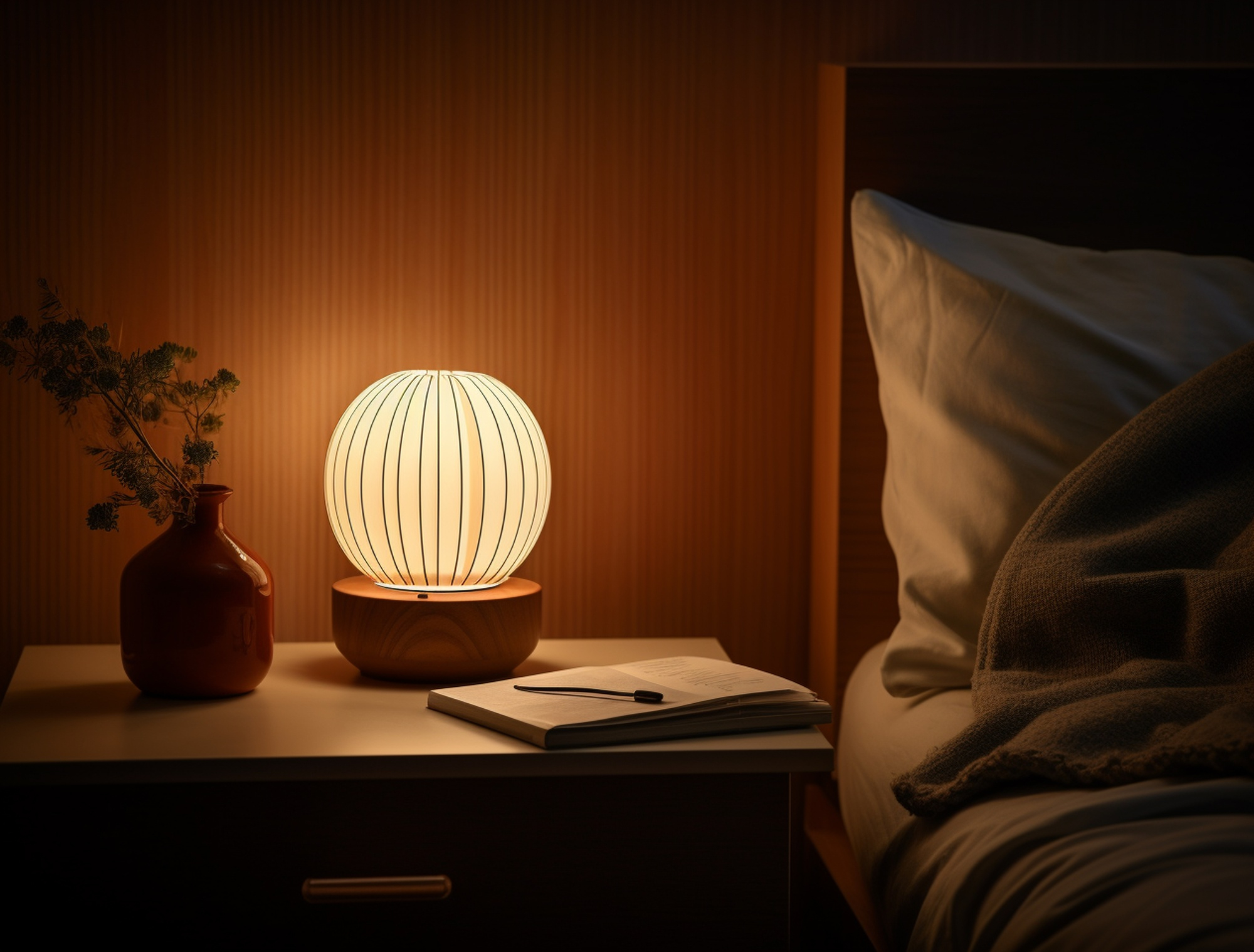
Swapping overhead lights for a warm lamp in the evenings is one of the smallest changes with the most noticeable payoff.
Shifting Your Schedule Gradually (Instead of Cold Turkey)
If your sleep schedule is really off — say, you’re falling asleep at 3 a.m. and waking at noon — trying to flip it to 10 p.m. and 6 a.m. overnight usually backfires. You lie in bed for hours unable to sleep, feel frustrated, and abandon the whole attempt.
A gentler approach works much better. Move your bedtime and wake time earlier by 15 to 30 minutes every few days. It feels slow, but it works with your circadian rhythm rather than fighting it. Within two to three weeks, most people with moderately disrupted schedules can shift by two or three hours without much struggle.
-
Set your target wake time
Decide on the wake time you actually want. Make it realistic — if your life requires 7 a.m., that’s your target. Write it down.
-
Move in small increments
Wake up 20–30 minutes earlier every two to three days until you reach your target. Don’t try to leap there overnight.
-
Shift your bedtime alongside it
As your wake time moves earlier, your bedtime should shift too — by roughly the same amount. This keeps your total sleep time consistent.
-
Hold the line on weekends
Sleeping in on Saturday and Sunday is the single most common reason sleep schedules drift back. Even one hour of social jet lag can undo several days of progress.
-
Use morning light every day
Reinforce each new wake time with outdoor light. This is what tells your body clock to actually shift — rather than just feeling groggy at a new hour.
What Helps — and What Doesn’t
There’s a lot of conflicting advice out there about fixing sleep. Some of it is genuinely useful. Some of it is well-meaning but won’t move the needle much on a disrupted schedule. Here’s a quick comparison of what tends to actually work versus what people commonly try without results.
❌ Less effective
- Forcing an early bedtime without changing your wake time
- Taking melatonin at high doses nightly
- Napping for more than 30 minutes in the afternoon
- Sleeping in to “catch up” on weekends
- Expecting results in two or three days
✓ More effective
- Anchoring a consistent wake time every day
- Morning light exposure within the first hour of waking
- Dimming lights and screens in the evening
- Shifting the schedule gradually, not overnight
- Keeping the same schedule on weekends
A note on melatonin
Melatonin isn’t a sleep drug — it’s a timing signal. Low doses (0.5 to 1 mg) taken about an hour before your target bedtime can help nudge your body clock earlier, which makes it useful for schedule shifting. But taking high doses nightly as a long-term sleep aid is a different thing, and it’s less effective than most people expect. The timing matters more than the dose.
The Daily Habits That Make a Quiet Difference
Your sleep schedule is shaped not just by what you do at night, but by how you spend the whole day. A few consistent habits build what’s called sleep pressure — the biological drive to sleep — so that by the time bedtime rolls around, your body is genuinely ready. For the full picture of how daily habits shape your sleep from morning through evening, that guide goes deeper.
Caffeine has a half-life of five to six hours. That 3 p.m. coffee is still half-active in your bloodstream at 8 p.m. and can quietly delay the onset of sleepiness.
Even a 20-minute walk helps build sleep pressure and raises your body temperature — which then drops in the evening, signaling that it’s time to sleep.
Meal timing is a secondary body-clock cue. Eating at consistent hours helps reinforce your circadian rhythm alongside light exposure.
Your core body temperature naturally drops as you prepare for sleep. A cool room — around 65–68°F (18–20°C) — supports that process and helps you stay asleep for deeper, more restorative sleep.
Even twenty minutes of something calm and screen-free before bed — reading, stretching, a warm shower — signals your nervous system that the day is genuinely over. See what to do before bed for practical ideas.
Short naps (20–30 minutes) earlier in the day are fine. Long or late-afternoon naps reduce the sleep pressure that helps you fall asleep at your target bedtime.

A bedroom that feels quiet, comfortable, and intentional does a lot of the heavy lifting for you.
When Your Environment Is the Problem
Sometimes the schedule is fine, but the bedroom itself is working against you. Light leaking through curtains at dawn. A mattress that’s too warm. Noise that wakes you at 5 a.m. just long enough to throw off the rest of the night. These things add up more than people tend to realize.
A few straightforward changes can make a real difference:
- Blackout curtains keep early morning light from waking you before your target time — especially useful in summer when dawn arrives well before most people need to be up.
- A white noise machine or fan smooths out background noise so small sounds don’t pull you into lighter sleep or wake you fully.
- Cooling bedding — linen sheets, a lighter duvet, or a breathable mattress topper — can quietly improve sleep quality without any effort on your part.
- Keeping the room dark during sleep and bright in the morning reinforces exactly the light cues your body needs to hold a consistent schedule.
Your bedroom should feel like a place you want to be. Not sterile or clinical — cozy, dark, quiet, and cool. When the environment supports sleep, everything else becomes a little easier.
What to Do When Nothing Seems to Work
Some nights, even with a consistent wake time and good habits in place, your body just doesn’t cooperate. That’s normal. The occasional bad night doesn’t mean your schedule isn’t improving. The worst thing you can do on a restless night is lie there watching the clock, because that frustration feeds the very alertness keeping you awake.
If you’ve been in bed awake for more than twenty minutes, get up quietly. Keep the lights low, do something calm, and return only when you feel genuinely sleepy. It feels counterintuitive — but staying in bed while frustrated trains your brain to associate your bed with wakefulness rather than rest.
If a disrupted sleep schedule has become a persistent pattern for months rather than weeks, and it’s affecting your daily life, it’s worth talking to a doctor. Things like delayed sleep phase disorder, sleep apnea, or anxiety can all look like a simple scheduling problem on the surface but need a different kind of support.
Fixing a sleep schedule isn’t about willpower or strict rules. It’s about sending your body consistent, clear signals — morning light, a steady wake time, a calmer evening — and then giving it enough time to respond. Most people see real improvement within two to three weeks. Start with one thing tonight. Your body knows how to sleep. It just needs a little help remembering when.