

Bedtime Habits for Better Sleep: 8 Things to Do Every Night
The last 30 minutes before you close your eyes matter more than most people give them credit for. What you do in that window either sets sleep up — or quietly ruins it.
This article may contain affiliate links. If you buy through these links, we may earn a small commission at no extra cost to you.
Nobody climbs into bed intending to sleep badly. And yet, night after night, millions of people lie there staring at the ceiling, mind still running at full speed, wondering why their body won’t cooperate. The frustrating part is that the fix usually isn’t complicated. It’s a matter of a few small bedtime habits — done consistently — that give your body and brain the right signals at the right time.
Sleep is a biological process, not a reward you earn by being tired enough. Your body needs specific cues to transition into it smoothly: falling light levels, dropping temperature, a slowing of mental activity. When those cues are present, sleep tends to come easily. When they’re absent — or replaced with bright screens, racing thoughts, and stimulating content — it doesn’t.
The bedtime habits for better sleep in this guide aren’t about doing more things before bed. They’re about doing the right things — and letting your body do the rest.

What you do in the hour before bed shapes the quality of every hour after it.
Why Bedtime Habits Matter So Much
Your brain is a pattern-recognition machine. When you repeat the same sequence of calming behaviors each night, those behaviors become signals — your nervous system starts interpreting them as a reliable cue that sleep is approaching. Over time, that learned association means your body begins its wind-down process earlier, melatonin rises more predictably, and falling asleep starts to feel effortless rather than forced.
This is why a bedtime routine works even when you’re not particularly tired. The ritual itself triggers the biology. And it’s also why inconsistency undermines sleep so reliably — when your pre-bed behavior is unpredictable, your body has no cue to prepare from, and sleep has to wait for you to become exhausted enough to override everything else.
What most people don’t realize is that you don’t need a perfect routine — you need a consistent one. Done simply and regularly, even the smallest bedtime habits for better sleep compound into something your body genuinely depends on.
The Bedtime Habits That Actually Move the Needle
Not all bedtime habits are created equal. Some have strong evidence behind them. Others are nice additions once the foundations are in place. Here’s what belongs in the first category.
Dim the lights at least an hour before bed
Light is the most powerful environmental signal your circadian rhythm responds to. Bright overhead lighting tells your brain it’s still the middle of the day — suppressing melatonin and pushing back your natural sleep window without you noticing. Switching to warm, low lamps as the evening progresses gives your hormonal system room to do what it’s meant to do.
This doesn’t require buying anything new. It just means turning off the main lights and moving to whatever warm lighting you already have. Candles work beautifully too. The shift in atmosphere is noticeable almost immediately, and the effect on sleep onset builds steadily with repetition.
Make putting your phone down non-negotiable
The case against screens before bed is often framed around blue light, but the real issue runs deeper. Scrolling keeps your brain in a state of continuous, low-level reactivity — always scanning, always responding, never truly settling. That neural activity doesn’t switch off the moment you put the phone down. It lingers for 20 or 30 minutes, sometimes longer.
Setting a firm phone cutoff — even just 30 minutes before bed — and filling that time with something genuinely passive makes a noticeable difference to how long it takes to fall asleep. Reading, light stretching, a calm podcast, or simply sitting quietly are all better than one more scroll. For a full list of things that actually help in that window, see what to do before bed.
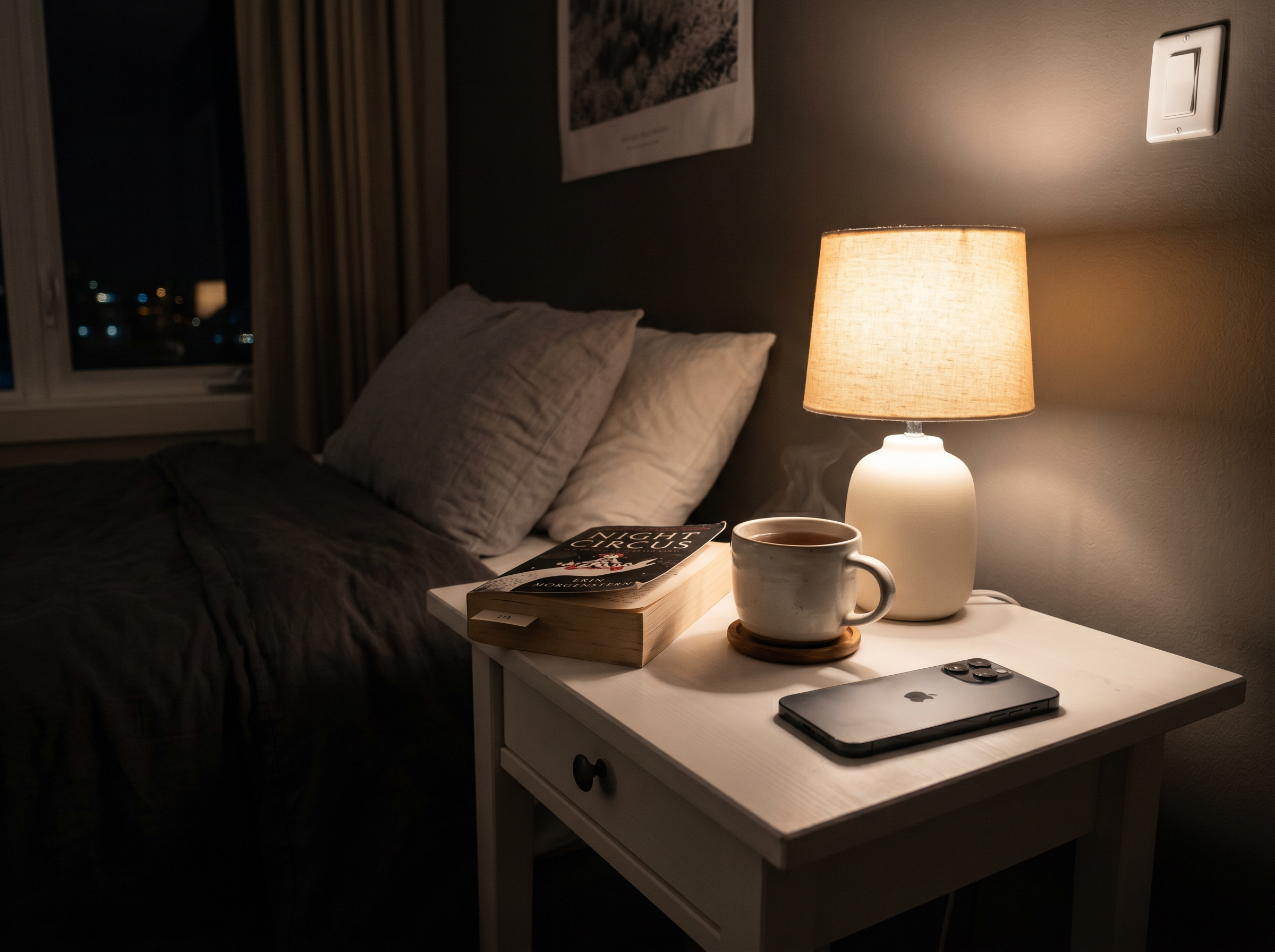
Putting the phone down isn’t just about blue light — it’s about giving your mind somewhere quiet to land.
Write something down before you close your eyes
One of the most common reasons people lie awake isn’t stress exactly — it’s the feeling of unfinished business. Your brain, left without structure at night, will naturally start processing whatever feels unresolved: tomorrow’s list, half-formed worries, things said or unsaid. It’s not trying to torment you. It’s trying to prepare you.
A few minutes of writing before bed gives that process a container. Jot down tomorrow’s three priorities, a few things that went well today, or simply whatever is circling in your head. Getting it onto paper signals to your brain that those things have been acknowledged and can wait until morning. It sounds simple — and it is. But it works.
Keep the bedroom cool, dark, and quiet
Your sleep environment isn’t separate from your bedtime habits — it’s part of them. A room that’s too warm, too bright, or too loud keeps your nervous system on mild alert even when you’re technically asleep, which is why you can get eight hours and still wake up feeling unrested.
The basics: aim for a room temperature between 16 and 19°C (60–67°F), block out as much light as possible with blackout curtains or a sleep mask, and reduce noise with earplugs or a white noise machine if your environment calls for it. These aren’t luxuries. They’re the physical conditions your body needs to reach and sustain deep sleep.
Good to know
The bedroom environment matters most during the second half of the night, when sleep is lighter and more easily disrupted. Even small amounts of light or noise — a charging cable LED, a partner’s phone screen — can shift you out of deep sleep without waking you fully. You’ll feel it in the morning without knowing why.
Bedtime Habits for Better Sleep — The Full Picture
Here’s a clear overview of the habits worth building into your evenings. Some are high-impact from day one. Others take a couple of weeks of repetition to fully click. All of them are worth the effort.
Habit 01
Dim the lights early
Switch from overhead lighting to warm lamps around 60 minutes before bed. This lets your melatonin rise naturally and shifts your body into wind-down mode without any effort.
Habit 02
Set your phone aside
A firm 30-minute screen cutoff before bed reduces the mental stimulation that keeps sleep at bay. Face it down, put it in another room, or switch to night mode — whatever makes the habit stick.
Habit 03
Take a warm shower or bath
Timed about 90 minutes before sleep, the body cooling that follows a warm shower is one of the most reliable biological triggers for sleep onset. Short and warm is all it needs to be.
Habit 04
Make a caffeine-free drink
Chamomile, passionflower, or any herbal tea you enjoy. The ritual of making something warm signals the end of the day in a gentle, repeatable way — and the warmth itself is quietly calming.
Habit 05
Write your worries down
A few minutes of journaling or list-making empties the mental clutter that accumulates by evening. Putting tomorrow’s tasks on paper gives your brain permission to stop rehearsing them.
Habit 06
Read something calming
A physical book is ideal — absorbing enough to quiet the mind, but not stimulating enough to keep it wired. Even 15 minutes of reading noticeably softens the transition into sleep.
Habit 07
Do a few minutes of slow breathing
A simple rhythm — four counts in, four counts hold, six counts out — activates the parasympathetic nervous system and physically lowers your heart rate. Do it in bed or just before.
Habit 08
Go to bed at the same time
Consistency anchors your circadian rhythm more than almost anything else. When your body knows when to expect sleep, it starts preparing for it in advance — and falling asleep becomes far less effortful.

The right bedtime habits turn your bedroom into a place your body genuinely looks forward to returning to.
What to Do on the Nights It Still Doesn’t Work
Even the best bedtime habits don’t guarantee a perfect night every time. Life gets in the way. Stress spikes. Some nights your brain just won’t cooperate. That’s not a sign the habits aren’t working — it’s just the reality of being human.
Don’t lie there forcing it
If you’ve been awake for more than 20 minutes and feel alert rather than drowsy, get up. Go somewhere dim and quiet — a comfortable chair, the sofa, anywhere that isn’t your bed — and do something calm until you feel genuinely sleepy. This protects the mental association between your bed and sleep, which matters more than most people realize for long-term sleep quality.
Skip the clock-watching
Checking the time when you can’t sleep is one of the most counterproductive things you can do. It triggers a mental calculation — how many hours left, how tired will I be, what if I don’t fall asleep soon — that raises cortisol and makes sleep harder to reach. Turn your clock away, or put your phone somewhere you can’t easily reach it. Not knowing the time removes a lot of the anxiety that keeps sleep at bay.
Treat a bad night as one bad night
The urge to compensate after poor sleep — by going to bed earlier the following night, sleeping in, or napping heavily — often perpetuates the problem. The most effective response to a rough night is to keep your wake time consistent the next morning, stay active during the day, and trust that your sleep drive will be strong enough to give you a better night naturally. It usually is.
Worth noting
Building bedtime habits for better sleep is a long game. The first week often doesn’t feel dramatically different. The second week, small things start shifting. By the third or fourth week, the routine feels natural rather than effortful — and that’s when the real improvement in sleep quality tends to become consistent. Give it time.
Where to Start Tonight
If none of this is currently part of your evening, the thought of changing everything at once can feel like too much. It is too much. Pick one habit — just one — and do it tonight. The most impactful starting point for most people is either dimming the lights earlier or putting the phone away 30 minutes before bed. Both are free, both are immediate, and both have a noticeable effect within a few nights.
Once that habit feels automatic — usually after two or three weeks — add something else. Layer the routine gradually until it becomes the natural shape of your evenings. That’s when the cumulative effect kicks in, and sleep stops being something you work at and starts being something that simply happens. And if you want to understand how the whole day feeds into your sleep, not just the last 30 minutes, that’s a good place to go next.
- Start with one habit and do it consistently before adding another
- Attach new habits to things you already do each evening — they’re far easier to maintain
- Give each new habit at least two weeks before judging whether it’s helping
- A simplified version of your routine on hard nights is far better than skipping it
- Track how rested you feel in the morning, not how quickly you fell asleep — that’s the real measure
Bedtime habits for better sleep aren’t about perfecting your evenings — they’re about making your evenings safe enough for rest. A little less stimulation. A little more warmth and quiet. Done consistently enough, that’s all it takes. Your body already knows how to sleep. These habits just remind it that it’s allowed to.