

How to Sleep with a Pregnancy Pillow (+ What to Do If You Don’t Have One)
The first night with a pregnancy pillow is a bit of an event. It takes up half the bed, your partner gives it a look, and then you wake up the next morning actually having slept.
If you’ve been stacking regular pillows into an increasingly elaborate arrangement every night and still waking up achy, you’re not alone. Getting comfortable sleep during pregnancy is genuinely hard — and the way you use your pillows makes more of a difference than most people realise.
This guide covers everything about how to sleep with a pregnancy pillow — the different types, how to position each one for back pain, hip aches, and bump support, and which trimester each setup works best for. And if you don’t have a pregnancy pillow yet, there’s a full section on how to replicate the support with regular pillows until you do.

The right pillow setup can completely change how you sleep during pregnancy.
Why a Pregnancy Pillow Actually Makes a Difference
When you’re pregnant, your centre of gravity shifts. Your hips widen. Your lower back curves more than it used to. And sleeping on your side — which is the recommended position from the second trimester onward — puts sustained pressure on whichever hip you’re lying on.
A pregnancy pillow solves a few things at once. It keeps your hips stacked and aligned so you’re not twisting your pelvis. It supports the weight of your bump so your lower back isn’t carrying it. And it stops you rolling onto your back in the night without you even realising.
The difference between sleeping with proper support and sleeping without it tends to show up clearly in how you feel in the morning. Less hip soreness. Less lower back tightness. More of the deep, restorative sleep your body genuinely needs right now.
Most women who try a pregnancy pillow say they wish they’d started using one earlier. The second trimester is usually the right time to begin — before the discomfort becomes severe and while you still have time to build the habit of sleeping with it.
The Main Types of Pregnancy Pillow
Not all pregnancy pillows work the same way, and the one that helps your friend might not be the best fit for you. Here’s a quick breakdown of what’s out there.
The most popular choice
A long, curved pillow that supports your head, runs along your front to cradle your bump, and tucks between your knees — all in one piece. It’s the one you’ve probably seen everywhere. The big advantage is that when you roll over at night, you just bring the pillow with you rather than rearranging everything from scratch.
The downside is size. These take up real space, and if you share a bed, your partner will definitely notice. But the support they provide is hard to replicate any other way. A good full-length pregnancy pillow is the closest thing to sleeping in a supported cocoon.
Maximum support, maximum bed space
A U-shaped pillow supports both sides of your body at once — front and back — so you don’t need to reposition when you turn over. It essentially wraps around you entirely. This is the most supportive option, especially if you’re dealing with significant back pain or just can’t seem to stay in one position.
It’s also the largest option by a considerable margin. Think of it as taking up a third of a standard double bed. If space is tight or you have a smaller mattress, this might not be the right choice — but for sheer comfort, it’s hard to beat. U-shaped pregnancy pillows tend to be the favourite among women in the third trimester when aches are at their worst.
Small, targeted, and underrated
A wedge pillow is a small triangular cushion that you place under your bump, behind your back, or between your knees. It doesn’t wrap around you — it just supports the specific area that needs it. This makes it much more compact and easier to use in combination with your regular pillows.
It’s also the most affordable option, and it’s easy to travel with. If you’re in the first or early second trimester and your bump isn’t large yet, a wedge might be all you need. Later on, some women use one alongside a full-body pillow for extra bump support. A pregnancy wedge pillow is a good first purchase if you’re not sure whether you need the full setup yet.
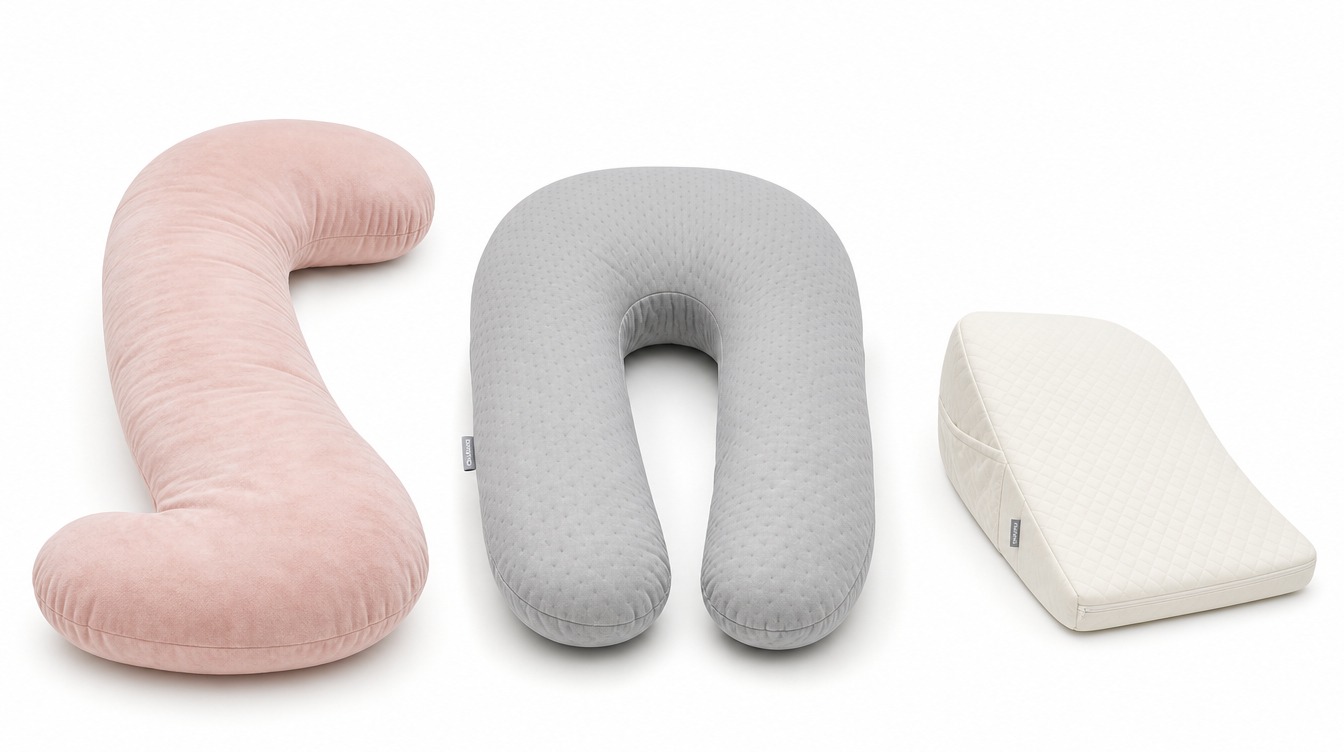
Different shapes solve different problems — it’s worth knowing which one fits your situation.
How to Sleep with a Pregnancy Pillow: Position by Position
Having the pillow is one thing. Using it correctly is what actually makes the difference. Here’s how to get the most out of each setup depending on what’s bothering you.
For hip and lower back pain
This is the most common use, and the fix is straightforward. Lie on your side and place the pillow between your knees, extending it down between your lower legs too. The goal is to keep your hips stacked directly on top of each other — not twisted forward or backward. When your top knee drops forward without support, it rotates your pelvis and puts strain on your lower back. The pillow prevents that rotation.
With a full-body pillow, hug the front of it to support your bump and let it run between your knees naturally. With a wedge, place it between your knees specifically and use a regular pillow for your head and bump if needed.
Your pillow between the knees should be thick enough to keep your hips level — but not so thick that it pushes your top knee up higher than your hip. If you’re waking up with a sore lower back, the pillow is probably too thick or positioned too high up your thighs.
For bump support
As your belly gets heavier — usually from around week 20 onwards — the weight of it pulling forward can cause lower back discomfort and make it hard to stay in a comfortable position. Tucking a pillow or the curved section of a full-body pillow underneath your bump takes that weight off and lets your muscles relax.
A wedge works particularly well here. Tuck it snugly under your bump from underneath rather than just resting it against the side — you want it to actually carry the weight, not just sit next to it.
For back support and stopping back-rolling
If you keep waking up on your back — which is common, especially in early pregnancy before the habit has set — tucking a pillow behind your lower back acts as a gentle barrier. You don’t need to wedge it in firmly. Just enough resistance to make rolling backward slightly uncomfortable, so your body naturally stays on its side.
With a U-shaped pillow, this is built in — the back section of the U does this automatically. With a C-shape or wedge, position a separate regular pillow behind you if needed.
For first trimester sleep
In the first trimester your bump isn’t large enough to cause major positional issues, but the fatigue and general discomfort are real. A wedge pillow or a regular body pillow between your knees is usually enough at this stage. It’s a good time to start training yourself to sleep on your side if that’s not your natural default.
For third trimester sleep
This is when most women get serious about their pillow setup, because the third trimester brings the most physical discomfort. A full-body or U-shaped pillow is worth it at this stage. Between the larger bump, hip pressure, rib discomfort, and more frequent waking, having everything supported at once makes a real difference to how rested you actually feel.
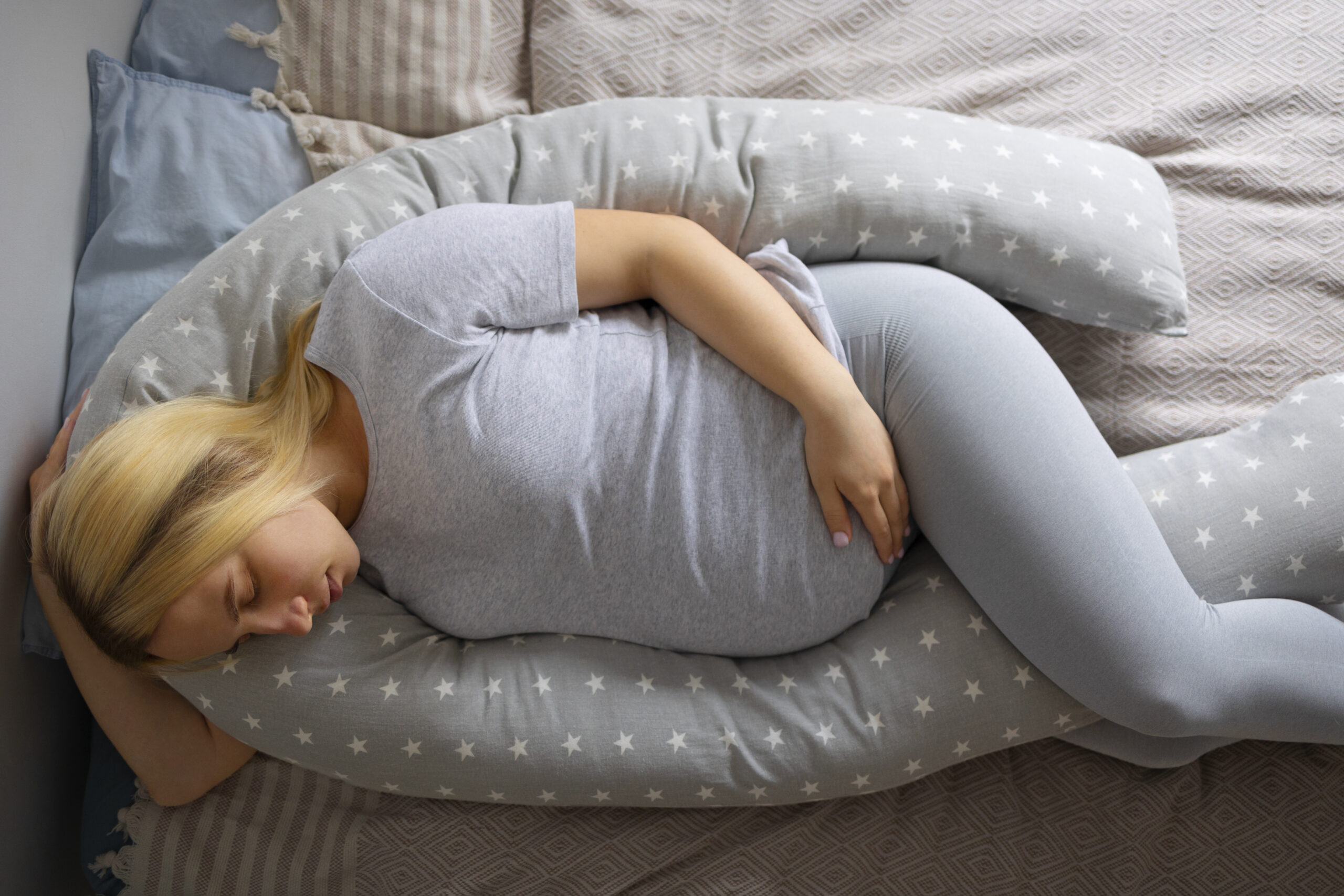
When everything is properly supported, sleep feels completely different.
Quick Comparison: Which Pregnancy Pillow for Which Problem
| Problem | Best pillow type | Why it helps |
|---|---|---|
| Hip pain | Full-body or wedge between knees | Keeps hips level and stops pelvic rotation |
| Lower back pain | Full-body or U-shape | Supports the whole body and prevents back-rolling |
| Bump support | Wedge under bump | Carries the belly weight and relieves spinal pressure |
| Rolling onto back | U-shape or pillow behind back | Creates a physical barrier without being uncomfortable |
| Heartburn | Wedge under upper body | Gentle elevation prevents acid from rising |
| General discomfort | U-shape | Supports both sides — no repositioning when you roll over |
| Limited bed space | Wedge | Compact, targeted support without taking over the bed |
What to Do If You Don’t Have a Pregnancy Pillow
You don’t necessarily need to buy anything to sleep better tonight. Regular pillows, arranged the right way, can replicate most of what a pregnancy pillow does — especially in the first and early second trimester when your bump is still manageable.
Fold a standard pillow in half lengthways. Place it between your knees and lower legs. This is the single most impactful thing you can do without any special equipment.
A small, firm sofa cushion or a folded blanket tucked under your bump works surprisingly well. It just needs to be dense enough to actually hold the weight without flattening.
Roll a spare duvet or a large pillow into a loose sausage shape and tuck it along your back. Firm enough to stop you rolling, soft enough that it doesn’t disturb you.
A regular body-length pillow or even two pillows stacked lengthways gives you something to drape your top arm over — which helps with shoulder comfort and stops you straining forward.
The honest truth is that stacking regular pillows works reasonably well in the early months. By the third trimester, when everything is heavier and achier and you’re waking up more often, the inconvenience of rearranging five pillows every time you roll over gets old fast. That’s usually when a proper pregnancy pillow starts to feel genuinely worth it rather than optional.
A pregnancy wedge pillow is the most affordable way to get targeted support without the cost of a full-body pillow. Under your bump or behind your back, it solves the two most common complaints at a fraction of the price. Worth considering as a first step if you’re not ready to commit to the full setup.
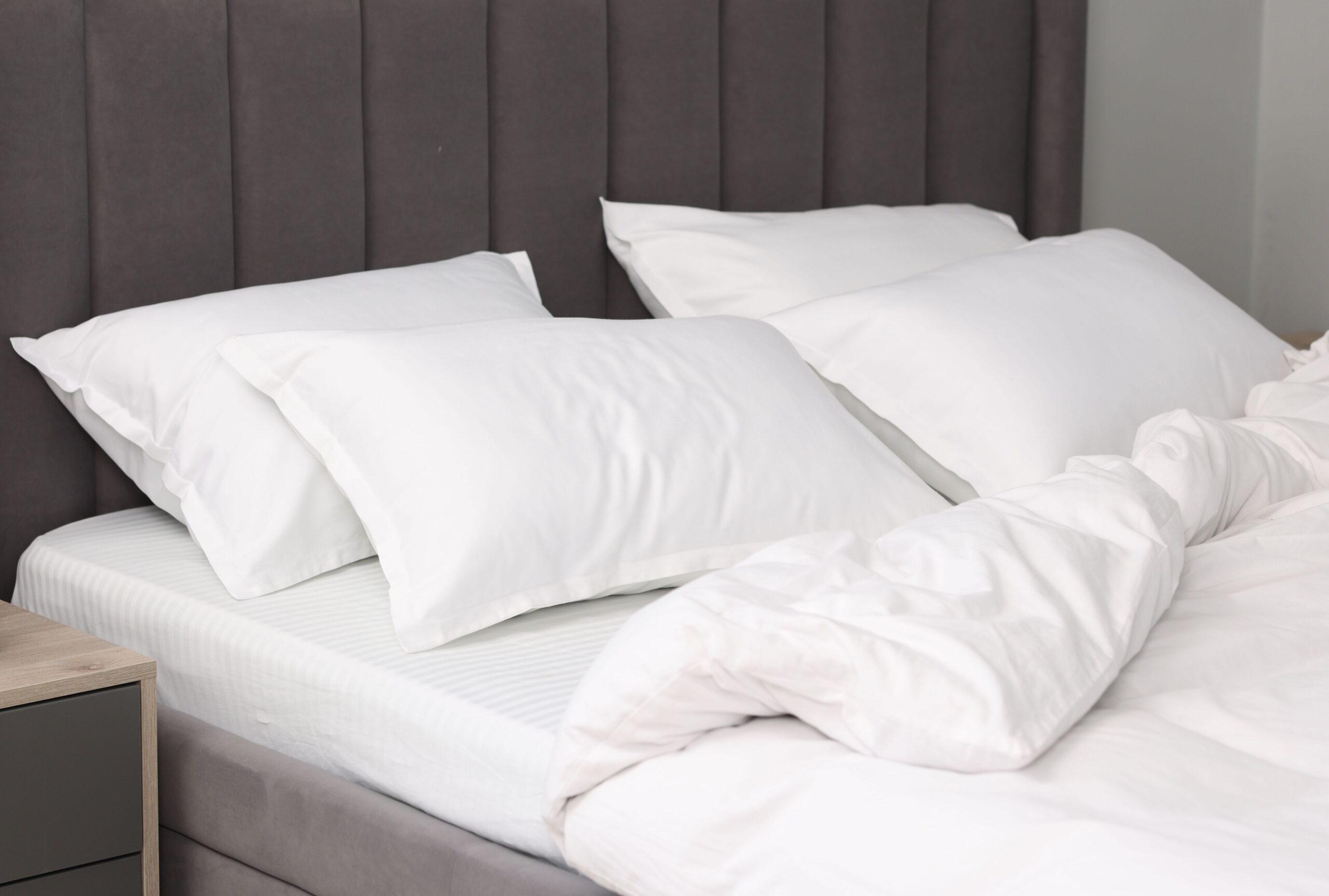
You can get a lot of mileage from regular pillows if you know where to put them.
Frequently Asked Questions
When should I start using a pregnancy pillow?
Most women find they want one somewhere between weeks 16 and 20, when the bump becomes noticeable enough to shift their centre of gravity and make standard sleeping positions uncomfortable. That said, there’s no rule — if you’re struggling to sleep comfortably in the first trimester, there’s nothing wrong with starting earlier.
Can a pregnancy pillow help with back pain during pregnancy?
Yes, noticeably. The main mechanism is hip alignment — when your hips stay stacked and level (rather than twisted by an unsupported top leg), the tension in your lower back reduces significantly. A pillow between your knees is the most direct way to achieve this. A full-body pillow or U-shape provides this support automatically and consistently through the night.
Is it safe to sleep with a pregnancy pillow?
Completely safe. Pregnancy pillows are just supportive cushions — they don’t do anything medically unusual. They’re designed to encourage side sleeping, which is the recommended position from the second trimester onward, so using one actually aligns with standard guidance.
Which side should I sleep on with a pregnancy pillow?
The left side is generally preferred because it supports better blood circulation to the baby and takes pressure off the liver. That said, right-side sleeping is not dangerous, and alternating sides through the night is completely fine. The pillow works the same way on either side — just flip it over when you roll.
What’s the difference between a C-shaped and U-shaped pregnancy pillow?
A C-shape (or full-body pillow) supports one side of your body — front or back depending on how you position it. A U-shape supports both sides simultaneously, which means you don’t need to reposition when you roll over. The U-shape takes up more space but provides more comprehensive support, making it the better choice for the third trimester or for women with significant back pain.
Can I keep using a pregnancy pillow after giving birth?
Absolutely. Many women keep using theirs postpartum — it can help with positioning during breastfeeding, supports recovery from a C-section, and is just genuinely comfortable. There’s no reason to stop using it once the baby arrives.
The Right Setup Changes Everything
Sleep during pregnancy is already working against you in a dozen different ways. Your pillow setup is one of the few things that’s genuinely within your control — and getting it right makes a real, tangible difference to how you feel each morning.
You don’t need to spend a lot or overhaul everything at once. Start with what you have. A folded pillow between your knees tonight costs nothing and might be exactly what your hips need. If you want to take it further, a wedge is an affordable next step, and a full-body pillow is worth it when the third trimester hits and comfort becomes genuinely elusive.
Whatever stage you’re at — first trimester or nearly there — you deserve to actually rest. The setup is simpler than it looks.
Good sleep during pregnancy isn’t about suffering through it. It’s about finding what supports you — and letting yourself rest properly.